Welcome to the magical world of Profanus
An intimate statement that begins in Rioplatense Spanish.
How difficult it is to begin to set down the ideas that inhabit my head, that grow, intertwine, mutate, and take hold.
This story begins in Buenos Aires, Argentina, some years ago. I worked at a museum of urban history and archaeology and, far from becoming entrenched in the anachronistic methods of museum design, I sought different ways to reach people, to be able to share with them even a little bit of the passion that research ignites in my soul. Every time we added a new guide to the team, the instruction we gave them was the same: if the visitor isn't moved, we haven't fulfilled our objective.
This museum explored the history of the country where I was born and the development of the city that hosts it, starting from the overlapping lives, years, and functions of a house made of brick and adobe. And I swear I’m not exaggerating: people would surf a sea of emotions during their visit, even gifting us a few tears.

When the idea of migrating became more solid, some of the work I did in this museum managed to extrapolate itself to my own story. I will return to this idea. It is not strange that a person who is about to leave everything they know behind seeks to understand themselves, to rethink themselves. The mental shifts that a migration entails are even stronger and more significant than the physical ones.
At first, I thought about applying to work at a museum in Barcelona. I even sat down to rearrange my resume to present it in a different country: Master of Art History, the header read. But of course, there, the term used is "Máster." I corrected it then. Two years of coursework and two years of thesis research. Wait, there, master's degrees last one year; how, then, do I translate my title?
Imagine that, if this was overwhelming, now I would have to understand a new worldview… To process a new ID card that included my mother's last name and stated that, besides being Argentine, I was also Spanish; to look for a new apartment, which would now be called a "piso"; to understand how local public health worked, the labor laws, the tax system, that there are streets where you must park on the left side during the first fifteen days of the month and on the right for the rest… And to get used to the fact that the second person plural would now be "vosotros" and not "ustedes," and that this paragraph should have started with "imaginaos" and not "imagínense."
Behind a wave of uncertainties that grew increasingly turbulent, doubts and questions rose without rest. Who am I? What do I want to do? Starting over can be liberating and overwhelming at the same time.
One thing I was clear about: Catalonia is a country in itself and its people are proud of their heritage. That is why, while I looked at all the objects I had collected during the 36 years I had been on this earth and chose which one to bring with me, which to leave behind, which to give away (and to whom), and which to sell, I approached the Casal de Catalunya on Chacabuco Street, in my beloved San Telmo neighborhood, to inquire about Catalan classes. All my friends laughed at my anxiety. I didn't even have plane tickets yet and I was already wanting to study another language. But there were no spots left. I was going to have to land without knowing how to speak the language of what would be my new home. You will (you will) be starting to understand that I am a person of strong obsessions.
But I was telling you about the museum, El Zanjón de Granados, and how that experience projected itself into my very bones. The visits always began the same way, talking about the family that had built the house. The year they had done it. What they did for a living, why they had been able to build such a large house, and the reasons it had such a particular appearance. It continued by presenting the restoration project, the family that had dedicated more than 20 years to investigating, shedding light, and returning life to that place. I spoke of Don Jorge, who started as my boss but ended up becoming much more. When I finally, through tears, gathered the courage to tell him I was leaving, he replied, "to watch a child grow up, you have to let them go." I’m writing this and the lump in my throat returns. I am quite a teary person, besides… And I continued by introducing the immigrant families who had come from many parts of Europe, seeking to leave behind hunger, war, and political persecution, who had inhabited that same house from the end of the 19th century until well into the 70s, during the 20th. There we call them "conventillos": each room in the house was inhabited by one, sometimes even two families, sharing their courtyards and terraces. In this house in particular, up to 100 people had lived together at the same time. You could hear Spanish, Italian, German, French, Russian, Polish being spoken… Neighbors became family even if they didn't even speak the same language. All of that could be told starting from some bricks that had once been set with adobe, and the word "family" did not stop repeating itself, as you have been able to witness just by reading these lines.
And what could my bricks, my scaffolding, my roots say? With what was the whole history of this house that is "me" amalgamated? My name is María Eugenia García. Now, María Eugenia García Domínguez. My paternal grandfather had arrived in Buenos Aires from Asturias with his parents, when he was very young, to grow up in a "conventillo" on Chacabuco Street, in the San Telmo neighborhood. There we have the first coincidences. There will be many more. During his adolescence, and at the School of Fine Arts of Avellaneda, he met Nora and they got married. Art has flowed through my family for several generations now. I even keep some woodcuts made by my great-great-grandfather, which remind me a little of those loose, beautiful, and somewhat schematic faces in Egon Schiele's drawings.
The surname Domínguez comes to me from my maternal grandfather, the first generation born on Argentine soil to a Galician couple who had met on the ship that took them toward their greatest adventure. If I was swimming in uncertainty, I couldn't begin to imagine what they must have felt running through their veins when they boarded a transatlantic liner, not knowing what awaited them on the other side. But back to my grandfather. He grew up in a country village dreaming of helping people, and he grew up to become a nurse. His parents didn't know how to read or write. One day, his best friend, hopelessly in love with a young lady, managed to get that long-awaited "yes" after inviting her for an ice cream, and, as she was going to go with a chaperone friend, he asked him as a favor to accompany her. That was how Oscar Domínguez met l'Elsa Vila, a Catalan woman who was more well-to-do and capricious and everything I didn't know until that moment that I needed to be happy.
 L'Elsa, or Beba, as we all call her, is almost 100 years old. She never spoke much about the circumstances of her life as a girl, although she kept some stories that gave us some clues. Every January 5th, we had to "be good" if we wanted the Three Wise Men to bring us gifts, because the "Patge Fumera," who was invisible, had entered through the chimney and was watching us. Her house had no chimney, but no one had stopped to consider that detail. The secret of the success that had suddenly struck our neighbor Pedro, he surely had found in an ear of wheat: "it must be the work of the Bocarrot," she said. "Eugenia, close (tancá) the door so the Bufarut doesn't get in" (later I would understand that it was the Rioplatense Castilianization of the Catalan imperative "tanca").

Grandma didn't say much about her childhood, but we did know the family was from Barcelona. There was a photograph of my great-grandfather floating around the house, dressed in a suit that always seemed pristine, unbreakable, pure to me: as if it had been carved for a sculpture. And a summer hat. "L'avi era molt galant" (Grandpa was very gallant). Many years later, skipping a generation, here I am, in that same city that served as the backdrop in that photograph. With my husband, Leandro García Pimentel, an artist. We didn't meet at art school, but it was he who invited me for a beer to tell me about the degree, and we ended up studying at the same place. It could pass for a coincidence, if you'll allow me. And how could I not tell you that we also came with our senior dog, Don Godard García de la Pelota. The coolest guy inhabiting this planet.
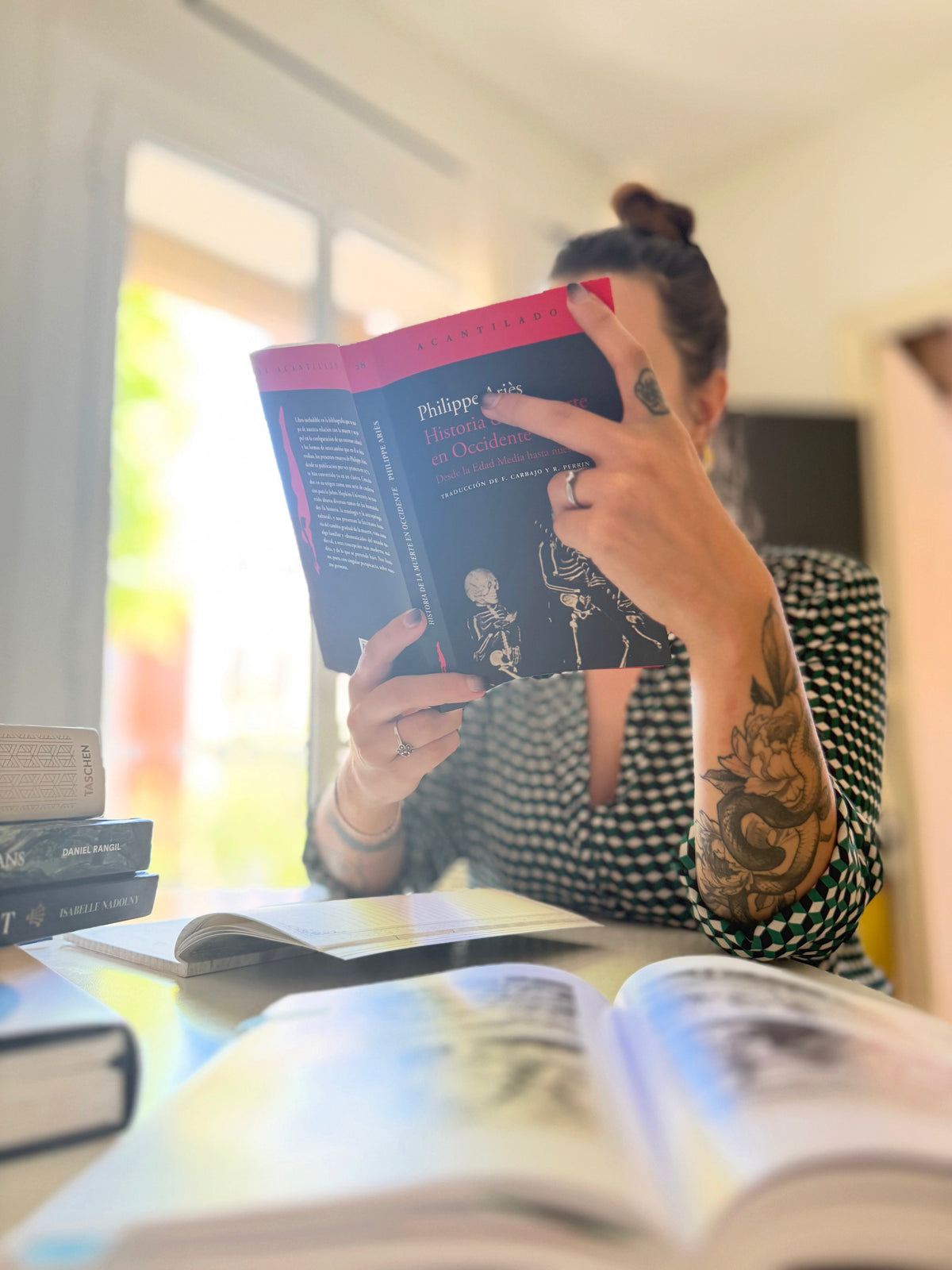
Before migrating, and trying to understand my roots, is when I began my research on Catalan mythology. It didn't seem very strange to anyone; I was always interested in understanding the stories that make a people and forge their identity and character. But I needed to arrive here to deepen it. I processed my library network card and dove in. Remember that I hadn't managed to get a spot to study at the Casal de Catalunya? All the books were written in Catalan, so I had to learn to read it before I could pronounce it: Softcatalà, AI (several), translators, a lot of intuition. That's how I discovered as many versions of these stories that had been born from oral tradition as I could. And I visited as many towns as time allowed.
When I worked at the museum, I believed that the particular stories of that house served as an excuse to talk about the development of Buenos Aires, but I soon understood that it was the other way around: that generalist history of an entire city was what ended up explaining the individuality of each of its parts, with their wealth and their misery. People with first and last names, who provided their own experiences for the construction of a collective narrative. And the more I discovered the stories of these lands, the more I understood that I could see myself reflected in their tales. These mythologies, at first distant, allowed me to understand a little more about myself.
And, finally, the moment was going to arrive when I would start studying Catalan. I realized the importance of using it, of connecting with people by speaking the same language that gives them so much pride. These legends have been transmitted from generation to generation with the sounds of a nation full of history and traditions.
Therefore, I sought help to write my research in Catalan. And I decided to translate it into Spanish and English so that everyone can know the characters, the places, and the myths that sustain this culture.
And why a tarot, you might ask… When you write oral stories, you freeze them. I didn't want to do that. Perhaps, by using the deck, these narratives will continue to mutate, enrich themselves, grow. And because, every time I need to, I call Argentina to ask my 100-year-old grandmother to cure me of the evil eye. The magic comes from her hand. Another coincidence.

Now I am Eugènia. Half of my life is in Argentina, and the other half is here, in Barcelona. But I don't feel fragmented, but rather elastic. My symbolic body grows and Profanus is the heart that unites all my singularities, gives them form, and invites the creation of community. This is my particular story with which to explain a larger phenomenon, even if that discourse ends up defining me as well. Like the stories that once passed through the house in Buenos Aires, which is now a museum.
If you have made it this far, welcome to the magical world of Profanus. The following entries will focus on my research process, on deepening the stories we have chosen to create the Profanus Tarot, on presenting possibilities for analysis and reading of the deck… And perhaps also, who knows, an occasional personal outlet, as this introduction was.
I invite you to network. Profanus was born from a personal process, but it will surely grow around a community.
Let us continue creating our history.